Tesla has started rolling out a new version of its Full Self-Driving software, and early reactions are all over the map. Some drivers say FSD v14.2.2.5 feels smoother and more “human.” Others report head-scratching behavior, erratic speed changes and turn signals firing on curvy roads for no obvious reason.
The whiplash is striking because this isn’t being pitched as a breakthrough release. On paper, v14.2.2.5 reads like a tune-up: safety tweaks, adjustments to driving profiles, and a new feature aimed at the messy final moments of a trip. But when the software controlling a 4,000-plus-pound vehicle starts sending mixed signals, literally, small quirks quickly become big public issues.
Who’s getting v14.2.2.5 first, and why that matters
The update began appearing around February 14 as part of Tesla software package 2025.45.10, rolling out in tight waves. Tracking suggests Tesla is prioritizing vehicles with Hardware 4 (often called AI4), typically newer cars, including the Model 3 and Model Y, plus the Cybertruck.
That creates an immediate sampling problem: the loudest early feedback is coming from a specific slice of Tesla’s fleet, not every Tesla on the road. And newer owners often have higher expectations, especially with a version number that sits between the current 14.2 line and a highly anticipated 14.3.
It also means people aren’t judging the same thing. One driver might focus on low-speed smoothness in town. Another cares about how the system handles a tricky left turn. A third is watching how it behaves on a winding two-lane road. A “better” update on one commute can look like a regression just a few miles away.
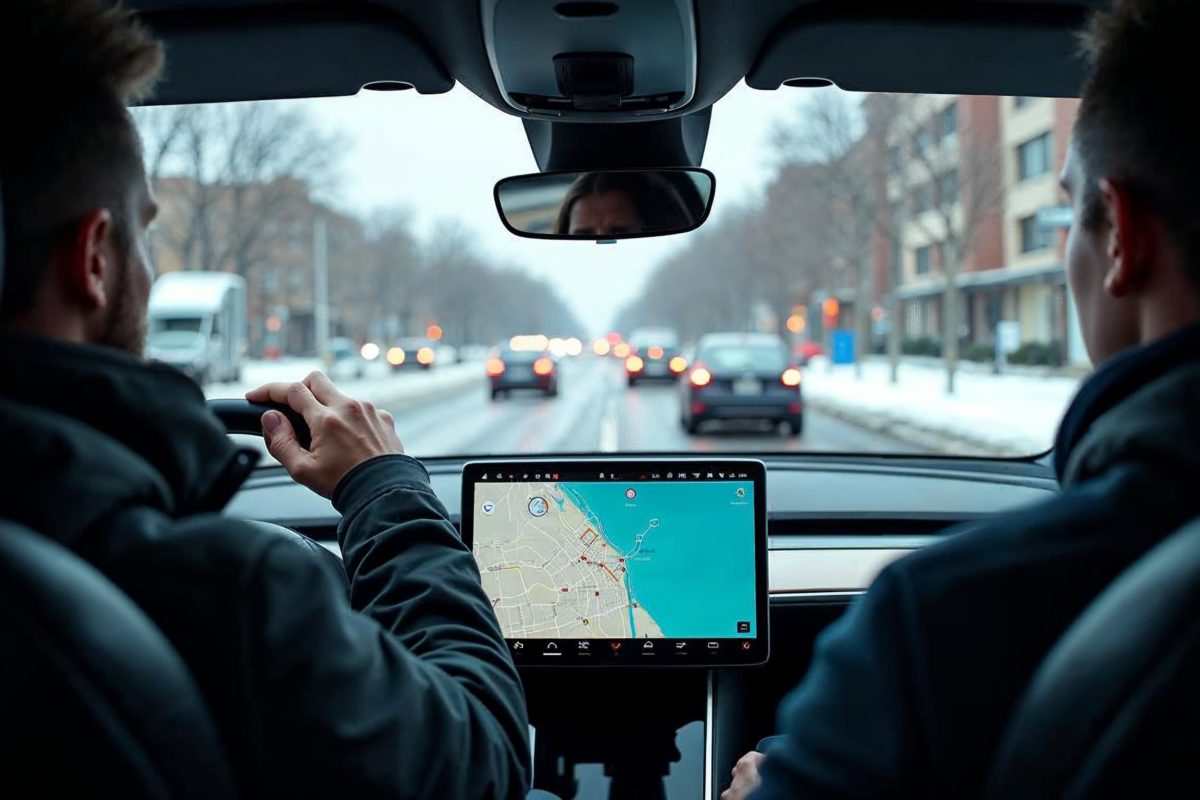
Conditions matter, too. Some reports describe winter driving, patchy snow, rough pavement, and low-contrast lane markings. In that environment, the margin for error feels smaller, and any odd decision stands out fast.
Speed profiles like “Hurry” and “Standard” are fueling the biggest arguments
The most debated change is speed behavior, specifically how FSD’s driving profiles behave. Testers say v14.2.2.5 can do what many Tesla owners have been begging for: a “Hurry” mode that better holds the speed limit and flows with traffic instead of inexplicably lagging under the limit.
But the same update is also being criticized for speed swings that feel hard to predict. For drivers supervising the system, predictability is the point. A car that alternates between overly cautious slowdowns and sudden, more aggressive acceleration can feel indecisive, even if each individual move is defensible in isolation.
Some owners also say the experience depends heavily on which profile they select, and whether the car appears to shift its behavior under certain conditions. If you think you’re in a calmer mode and the system changes its strategy, it can read like a bug, even if Tesla’s internal logic is trying to reduce risk.
This is the recurring problem with advanced driver-assistance systems: transparency. If the car doesn’t clearly communicate why it’s slowing down, or why it’s speeding up, drivers lose confidence. Tesla markets this as “Full Self-Driving (Supervised),” which means the human is still responsible. But supervision works best when the system’s decisions are legible.
The turn-signal issue: bug, overcaution, or a social mismatch?
If v14.2.2.5 has a signature controversy, it’s turn signals. Some drivers report the car repeatedly activating the blinker on tight curves, without an intersection, exit, or lane change. On a winding road, that can make the vehicle look uncertain, even though it’s simply following the bend.
Supporters argue it could be a form of caution, signaling an intent to “turn” through a sharp curve. Critics counter that in American driving norms, a blinker is a promise: you’re changing lanes, turning onto another road, or taking an exit. Using it for a curve can confuse everyone around you.
That confusion isn’t theoretical. A driver behind you might think you’re pulling off. A cyclist might brace for a lateral move. A pedestrian might hesitate at the curb. Even if the Tesla stays perfectly in its lane, it’s broadcasting noisy information, and traffic runs on communication as much as geometry.
And it’s hard to score with simple metrics. You can count hard braking events or disengagements. But “unnecessary blinker use” is contextual. Still, it matters: readability is part of safety, not a cosmetic detail.
“Arrival Options” targets the last 656 feet, where FSD has long struggled
One of the most concrete additions is a feature called “Arrival Options,” designed for the end of a trip. The idea: when you set a route, you can specify how you want to arrive, such as the type of parking or approach, so the car doesn’t make an annoying or awkward choice in the final stretch.
Tesla is aiming at a notorious weak spot: the last 200 meters, about 656 feet. That’s where lane markings disappear, parking lots get chaotic, and informal human negotiation takes over. It’s also where low-speed mistakes feel most memorable, because you’re close to curbs, poles, pedestrians, and cars maneuvering in tight spaces.
In practice, the feature could prevent the car from aiming for a weird entrance, committing to a too-narrow lane, or stopping in a spot that makes no sense for your destination. But some early feedback suggests the arrival flow may also introduce bugs or unexpected behavior, exactly where drivers least want surprises.
Weather and driver-incapacity safeguards add safety, while complicating the experience
Beyond the visible quirks, v14.2.2.5 appears to push more adaptive safety behavior. Reports describe the system automatically limiting top speed and dialing back driving aggressiveness when it detects bad weather like rain or snow.
From a safety standpoint, that’s easy to defend. From a user experience standpoint, it can feel like the car is ignoring your chosen settings, especially if the interface doesn’t clearly explain what changed and why. That same transparency problem shows up again.
The update also includes a notable shift in philosophy: handling potential driver incapacity. The concept is that if the system detects the driver can’t supervise, due to a medical event or loss of alertness, the vehicle can move to a safer position and stop. It’s a meaningful safety promise, but it also raises questions about detection accuracy and false alarms.
That’s the story of v14.2.2.5 so far: real safety-minded improvements living alongside everyday behaviors that can undermine trust. For Tesla, the challenge isn’t just making FSD better on average, it’s making it feel consistent enough that drivers, and everyone sharing the road with them, can understand what the car is about to do.
Key Takeaways
- FSD <strong>v14.2.2.5</strong> is rolling out via <strong>2025.45.10</strong>, with priority for <strong>AI4</strong> vehicles.
- Speed profiles, including <strong>Hurry</strong>, seem to hold the speed limit better, but inconsistencies remain.
- Turn signals triggered on curves with no intersection are fueling criticism about predictability in traffic.
- <strong>Arrival Options</strong> target the last <strong>200 meters</strong>, a longstanding weak spot, with mixed feedback.
- Weather safeguards and incapacity handling reinforce the <strong>Supervised</strong> approach, while also making the experience more complex.
Frequently Asked Questions
When did Tesla start rolling out FSD v14.2.2.5?
The rollout was first observed starting February 14, with additional waves in the following days, bundled with software version 2025.45.10.
Why do some drivers consider this version "confusing"?
Feedback is highly mixed: some report smoother driving and better speed tuning, while others see noticeable, hard-to-interpret behaviors—like turn signals activating during a curve with no intersection and profile changes that feel unpredictable.
What do the Arrival Options change in FSD v14.2.2.5?
The feature lets you specify your arrival intent—especially the type of parking—when you create a route. It aims to better handle the last 200 meters, an area where navigation and maneuvering errors are common.
What safety improvements are associated with this update?
Two main areas stand out: automatic adjustment of speed and driving profile in rain or snow, and a safety feature designed to bring the vehicle to a stop if the driver is detected as unable to supervise.
Is this update a major overhaul of Tesla's self-driving?
No. It’s described as a substantial refinement with targeted fixes and improvements rather than a generational leap. It sits between the 14.2 series and the highly anticipated 14.3.
Sources
- Tesla FSD v14.2.2.5 Analysis: A Complex Blend of Safety … – Tesery
- Tesla FSD v14.2.2.5: The Smoothest Update Yet! – YouTube
- Tesla FSD v14.2.2.5 Major Refinement – AutoPilot Review
- Tesla FSD v14.2.2.5 Rolls Out via 2025.45.10: What's New – basenor
- Tesla Full Self-Driving v14.2.2.5 might be the most confusing release ever
En tant que jeune média indépendant, The Inquirer 🇫🇷 a besoin de votre aide. Soutenez-nous en nous suivant et en nous ajoutant à vos favoris sur Google News. Merci !